Mmm I kinda see. That should be good enough for my assignment. Thank you!
1 Like
Uhh, idk binary. 1 and 0 ig
1 Like
Aya is so smart 
 she should tutor me
2 Likes
i mean you can always send the topics/questions you need help with here and i can try to help :]
4 Likes
Late reply, but I think I can explain it in a shorter or at least more understandable way than (@)Aya:
Normally in maths we use base 10, where there is 0, 1, 2, 3, 4, 5, 6, 7, 8, 9, and then 10 is 2 digits, resetting the cycle of numbers. Every number is added up with this formula: [base ^ (place of number - 1) * n] so 432 is: 10^2 * 4 + 10^1 * 3 + 10^0 * 2
So, by this logic, in any other base (such as binary or in other words base 2), if we have the number 1011 for example, it would be equal to: 2^3 * 1 + 2^2 * 0 + 2^1 * 1 + 2^0 * 1 in base 10, or in other words, 11
Here’s one with easier to understand notation (in binary)
11101:
2^4 + 2^3 + 2^2 + 2^1 + 2^0
x x x x x
1 1 1 0 1
|| || || || ||
16 + 8 + 4 + 0 + 1
(which is equal to 29)
2 Likes
More understandable? (cuz personally I barely understand Aya’s ._.)
ohhhh after much thought that does make much more sense. Binary numbers is a very confusing way to do math xD
The only thing I don’t quite understand is how 2^0 * 1 = 0. Because based upon the other answers wouldn’t it be 0?
n^0 always equals 1, that’s the rule of exponents, so 1 * 1 = 1
2 Likes
oh gotcha. Thanks for helping!
2 Likes
the audacity
how dare you
(jk)
6 Likes
I mean you explained it well, just kinda over-complicated it lol
2 Likes
I think you both is very good,but I like aya’s more(because my way is more similar to her
Im a female )
Screw 20chars
2 Likes
Ah!sorry sorry(((((((
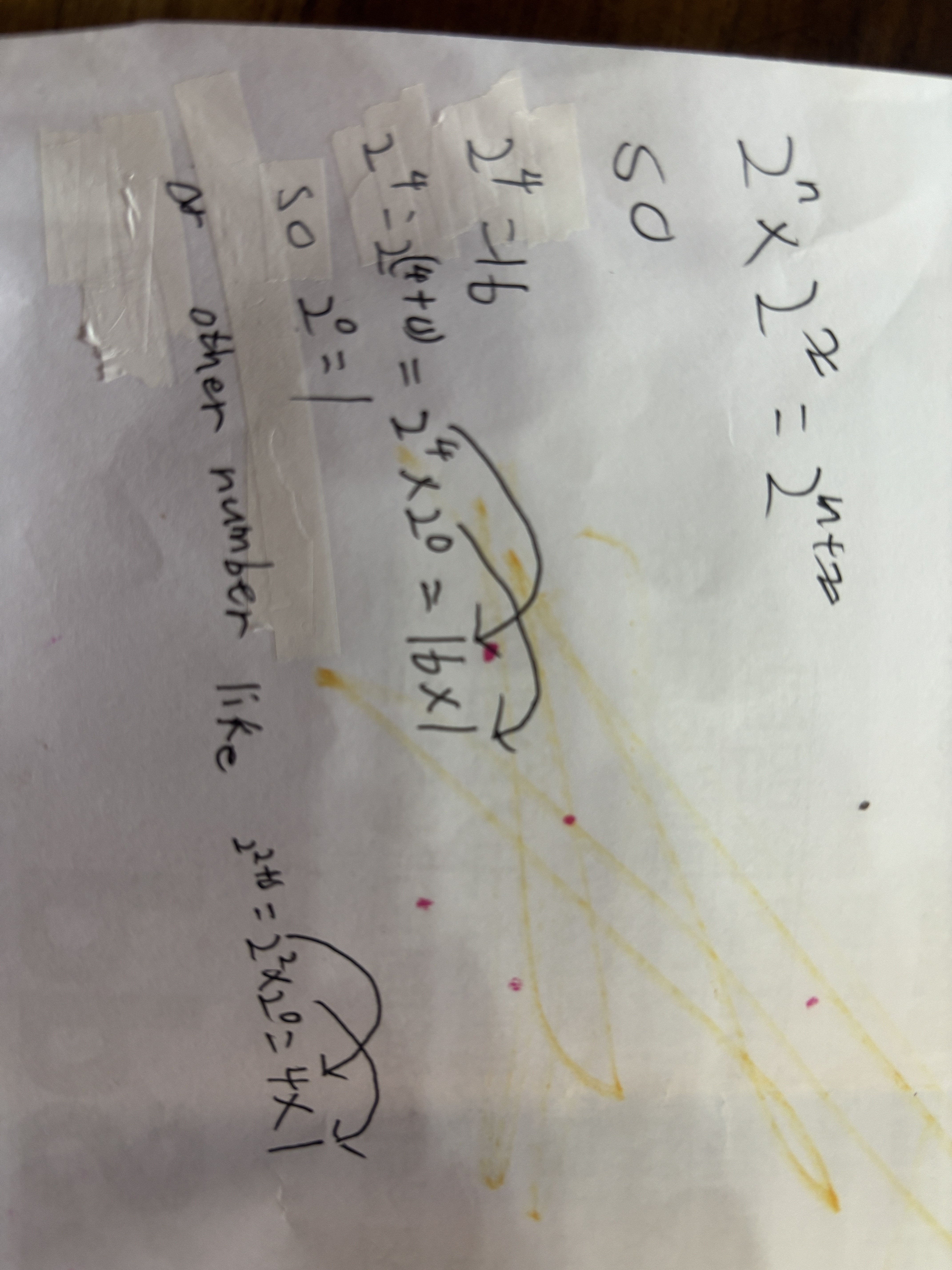
Explain:2² * 2²=2²⁺² so 2⁴=2⁴⁺⁰=2⁴ * 2⁰=16*1
So 2⁰=1
where did you get 16*2^0 from, what?
Ah, you explained it in a weird way, I see you just mean that
nx * ny = xx + y
so by that logic
n4 * n0 = n4 = n4 * 1
maybe try using variables and not just a random number because otherwise it’s hard to know you mean that (since you only gave 1 example and didn’t even use any words)
1 Like
Stuff I’ve learned this week:
- Average rate of change of a function:
ARC[x, y] = (f(x) - f(y))/(y-x) (ARC = average rate of change and [x, y] is the interval) - Slope-intercept form of a function:
y = mx + b (m = slope and b = yint) - Any variable with an arrow on top of it is a vector quantity.
- When you’re solving an inequality, flip the sign whenever you’re multiplying/dividing by a negative.
- There are OR and AND parts of inequalities.
- Some medicine doesn’t work, mom.
4 Likes
Googling these topics up and saying that you’ve “learned” them is wild🙏
Lil bro ur in like 5th grade god damn